
Introduction

They share the same target of integrating poor and underserved people in society into the financial sector. These organizations assist people in saving, accessing loans, and building successful lives. Despite their shared objectives, there is a big difference in their operational mechanisms. One needs to know the difference between SACCOs and microfinance organizations if they aspire to make informed decisions in choosing what suits their needs best.
What is Microfinance?

Microfinance, as a name suggests, is a type of financial service provided to poor and impoverished people, as they are not eligible to access normal banking facilities. This service basically helps these people with loans, saving schemes, and even insurance and transfer facilities. The primary recipients of these facilities are business owners, farmers, and women across the world.
Typically, microfinance institutions could be private, non-profit, or even governmental initiatives. Earning or improving the chances of earning money is the central focus, and the whole microfinance theory is wrapped around the assumption that “poor people need access to money, and access to money enables them to improve their businesses and move out of the poverty trap.”
In microfinance, there is a system called group lending. In this system, a group of people is identified, and all of them sign for each other. This implies that if an individual does not pay, all others in this group are required to pay. This forces an individual to pay.
What is a savings and credit cooperative (SACCO)?
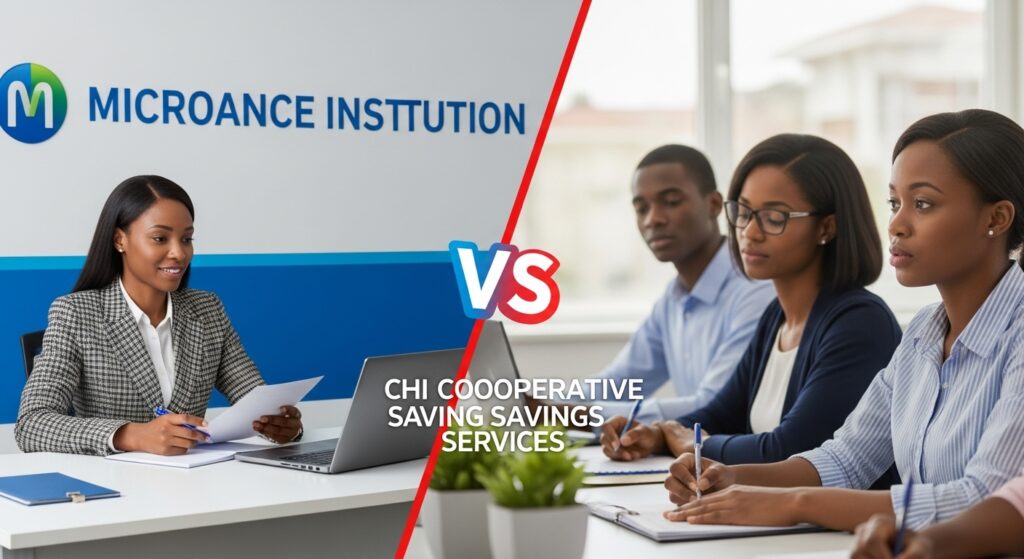
A Saving and Credit Cooperative Society, abbreviated as SACCO, is a collective unit of people, either based on work, profession, village, or religion, among other differences, with a common goal of saving money, which serves as the main source of loan services among its members.
The basic concept of a SACCO is self-help through cooperation. Members are also the owners and the customers. Each member has one vote, irrespective of his deposits. A SACCO operates on a democratic way, and it aims to enhance the economic welfare of all its members and not to generate profit for third-party owners.
Savings come first in a SACCO before borrowings. Before one can borrow, they must have built up some savings. Financial discipline and long-term security are fostered by this.
Difference in Ownership
One of the biggest differences between microfinance and SACCOs is ownership.
Microfinance institutions are owned by private investors, NGOs, and governments. The ownership does not include or involve the clients borrowing from them. The clients are just mere customers.
SACCOs, on the other hand, are owned by the members. When one joins a SACCO, they immediately become part-owners. This means that they have a say in how the SACCO is conducted.
So, microfinance is controlled by institutions, but SACCOs are controlled by members.
Different in Purpose
In general terms, the primary purpose of microfinance is poverty reduction and entrepreneurial development. Microfinance essentially revolves around providing access to credit services to poor individuals so that they can establish enterprises and achieve livelihood!
What is the main objective of SACCO?

Financial security is the main aim of SACCO, and the help is reciprocal among the members. It provides the members with the facility of saving regularly, as well as low-cost borrowings, which leads to
Simply put, microfinance institutions are likely to focus more on business, while SACCOs focus more on financial discipline.
Difference in savings
Savings, too, differ significantly between the two models.
Saving is optional in the context of microfinance. Many MFIs focus on providing loans and advancing money. Saving can be optional in such organizations.
In SACCOs, the compulsion to save exists. People must save regularly to be eligible to borrow from the SACCOs. Individuals save more to borrow more.
Thus,microfinance institutions are primarily loan-based organizations, whereas SACCOs are
Difference in Interest Rates The interest rates of loans available in MF institutions or organizations are normally high. This is because when serving many small borrowers, they are exposed to higher costs as well as greater risks.
SACCO loans are provided at quite low interest rates. Since the money borrowed belongs to the members, the interest rates cannot be high.
Therefore, borrowing from a SACCO can be considered cheaper compared to borrowing from a microfinance institution.
Difference in membership and access

Anyone can join microfinance as long as they satisfy basic criteria. One does not need membership or saving prior.
SACCOs are closed systems. Registered members only save and borrow in SACCOs. Membership is usually available only to people with a common bond.
In summary, microfinance is open access, while SACCOs are member-only
Difference in Loan Security
In microfinance institutions, group guarantees are common. In this approach, the borrowers form groups and promise to support each other in loan repayment.
SACCOs rely on savings and guarantors as security. If a member is unable to pay, his savings can be deducted. Therefore, microfinance relies on group pressure, whereas SACCO relies on savings and trust.
Difference in the Use of Profit

Profit earned by the microfinance institutions accrues to the owners or investors and is reinvested in the institution.
SACCOs will share surplus money among the members as dividends or use it to enhance the service portfolio.
Therefore, while microfinance benefits institutions, SACCOs benefit members directly.
Difference in Regulation
Depending on the country, there is regulation of microfinance institutions either as financial companies or NGOs.
SACCOs are governed by the set cooperative laws and regulated by the relevant cooperative authorities.
They operate under different legal systems.
Risk and Sustainability Difference
This is where microfinance institutions often operate on the basis of external funding, with considerable risk in case of mass defaults by borrowers. SACCOs depend on the savings of members, hence long-term stability.
Difference in Social Impact

Microfinance emphasizes the concepts of empowerment and entrepreneurship, especially among women and poor people.
SACCOs emphasize community development, as well as financial discipline.
Both have social value, although the difference is in their consequences.
Similarities Between Microfinance and SACCOs
Despite all these differences, they also have some things in common.
• Both serve people ignored by banks
• Both offer small loan services
• Both promote financial inclusion
• Both support small businesses
• Both reduce dependence on moneylenders
Benefits of Microfinance
• Easy access to loans
• No need for large savings
• Supports business growth
Disadvantages of Microfinance
• High interest rates
• Risk of debt problems
Advantages of SACCOs

• Low-cost loans
• Strong savings culture
• Member control
Disadvantages of SAC
• Needs time to save money
• Limited funds in small SACCOs
Which One is Better?

There is no best choice. It depends on your needs.
In case one wants quick funds and does not save, then microfinance is perfect.
Long-term growth and cheap credit? If you need any, the answer is SACCO.
Conclusion

Microfinance, and Savings and Credit Cooperatives, while both aiding those who cannot afford banks, do it in a vastly different manner. For microfinance, it is institution-driven, loan-oriented, and entrepreneurship-focused, while for SACCOs, it is member-driven, savings-oriented, and built upon trust and cooperation.
Microfinance allows individuals to start earning.
SACCOs enable the public to start saving.
Knowing the distinction enables people and groups to select the most appropriate financial system to suit their future plans.